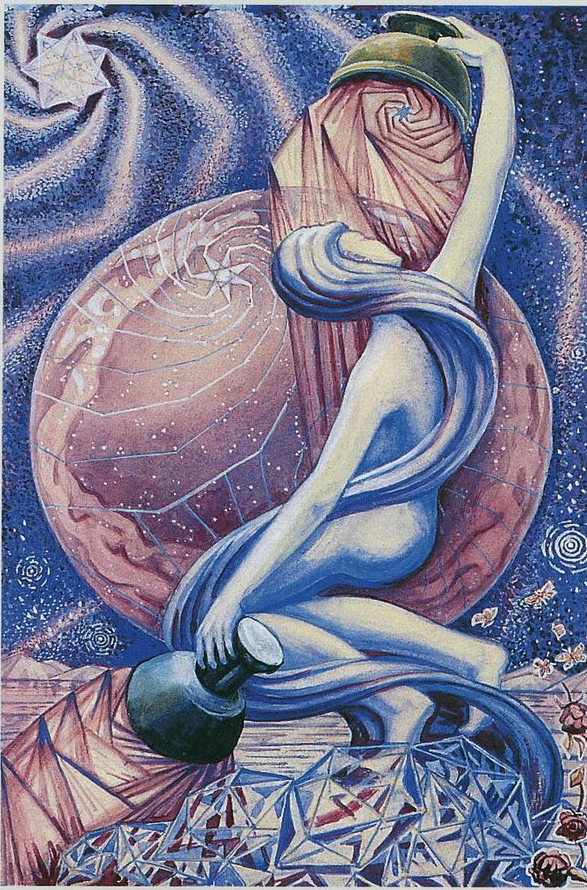
Φύσις κρύπτεσθαι φιλεῖ, Nature loves to hide.
In Part One we started with signs and their involvement in the generation of meaning, and examined the Semiosphere as explored by Yuri Lotman. We also saw how in The Veil of Isis Pierre Hadot followed the sign of the veiled goddess through Western thought where Isis came to represent the secret of Nature, and later the mystery of Being itself. We also collected some writings of Aleister Crowley in relation to the subject as the basis of a meditation.
It would be helpful to introduce some Antoine-Joseph Pernety into the air. In his work The Hermetic Apocalypse he provides a definition of Isis; that Isis is regarded as the universal Goddess of Paganism, and is worshipped under different names: “Ceres, Juno, the Moon, the Earth, Proserpine, Thetis, the Mother of the Gods or Cybele, Venus, Diana, Hecate, Rhamnusia (Nemesis), etc., and even Nature herself, were all one and the same as Isis.” Thus is Isis thus known as Myrionymous, or the Goddess of a Thousand Names.
So what Isis is, and what the veil is imagined to conceal may change shape. Most importantly, however, in the symbol of the veiled goddess, is that the veil is not divorced from her. While the veil conceals, it also provides us with something that allows us to see her more fully. The presence of the veil invites us to lift it, and in so doing, that which we seek would as a result stand before us, the naked thing itself.
Hadot also wrote that the naked goddess who “slumbers on the ground and abandons herself to love” is an early version of the Great Mother. He also notes in relation that Isis, like Nut, appear as a white sow (a pig whose body is filled with night sky), and that Set’s head been interpreted as a pig. He raises the image of Isis sitting with wide-open legs on the back of a pig, and points out that female genitals in Greek and latin were called “pig”, though the association can be traced further in the primitive name for the cowrie shell. This negative Great Mother, Hadot writes, “selects one young man after another to love and destroy”, and in this way she becomes “the harlot”, and “the sacred prostitute”, as the “vessel of fertility”.
The Great Mother represents the One substance from which all is formed. And perhaps we perceive one another and the world through a projection upon the veil. The goddess’s unveiling is always happening in the process of Nature unveiling herself in her infinite manifestations, which are the children of Nuit, and they are events.
Magnum miraculum est homo.
Liber AL Chapter One, Verse 12. Come forth, o children, under the stars, & take your fill of love!
Crowley’s 1923 Commentary: The Nature of an Act: its virtue. All acts are in truth acts of Love. Fulfill all Loves that may be, to the full. Be this in Light, before all Stars, that all may see and rejoice.
13. I am above you and in you. My ecstasy is in yours. My joy is to see your joy.
1923 Commentary: Nuit expressed in an Eidolon. Nuit is formed into an Image of a Woman, that She may be the symbol of all ways of going in Love.
Her relation to Mankind. She is our Goal and our own heart’s essence of Will.
Her Mother-Joy as Nature. She is Nature, who is glad of the birth of all that cometh forth.Commentary for 14. (which had been omitted due to its length): The Secret of Joy. The Soul of Man flameth forth in Love unto the utmost Spaces of the Stars, and hath his joy of all of them.
All events are children of Nuit. Every event doth fulfil some Love, and each is thenceforth of the Body of Nuit, which is event as Her Soul is Lust to bring forth, and the chance so to do.
Detour Lust, The Scarlet Woman, and BABALON (click to open)
“I am the Snake that giveth Knowledge & Delight and bright glory, and stir the hearts of men with drunkenness. To worship me take wine and strange drugs whereof I will tell my prophet, & be drunk thereof! They shall not harm ye at all. It is a lie, this folly against self. The exposure of innocence is a lie. Be strong, o man! lust, enjoy all things of sense and rapture: fear not that any God shall deny thee for this.” – Liber Al Vel Legis 2.22
Crowley proclaimed himself the prophet of the Aeon of the Child, Horus, and set it within a framework to be followed by the Aeon of Maat, of Truth, Justice and Balance. We had left the Aeon of the Dying and Resurrecting god, Osiris. We have woven our fingers through the hair of eternity.
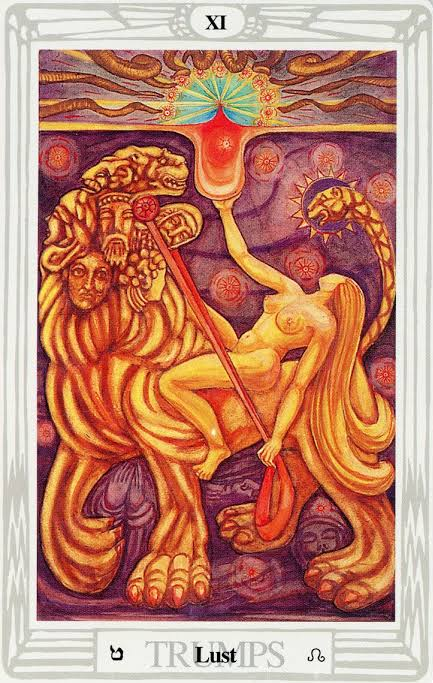
Crowley in his Thelemic Qabalah had chosen that the Strength card would be presented as Lust. His description of the card reveals a lot, but highlighting here that in it the woman represents the Moon (Isis) fully illumined by the Sun:
“The seers in the early days of the Aeon of Osiris foresaw the Manifestation of this coming Aeon in which we now live, and they regarded it with intense horror and fear, not understanding the procession of the Aeons, and regarding every change as catastrophe. This is the real interpretation of, and the reason for, the diatribes against the Beast and the Scarlet Woman in the XIII, XVII and XVIII-th chapters of the Apocalypse; but on the Tree of Life, the path of Gimel, the Moon, descending from the highest, cuts the path of Teth, Leo, the house of the Sun, so that the Woman in the card may be regarded as a form of the Moon, very fully illuminated by the Sun, and intimately united with him in such wise as to produce, incarnate in human form, the representative or representatives of the Lord of the Aeon.
[…]
There is a further description:
There is in this card a divine drunkenness or ecstasy. The woman is shown as more than a little drunk, and more than a little mad; and the lion also is aflame with lust. This signifies that the type of energy described is of the primitive, creative order; it is completely independent of the criticism of reason. This card portrays the will of the Aeon. In the background are the bloodless images of the saints, on whom this image travels, for their whole life has been absorbed into the Holy Grail.
Behind the figures of the Beast and his Bride are ten luminous rayed circles; they are the Sephiroth latent and not yet in order, for every new Aeon demands a new system of classification of the Universe.
At the top of the card is shown an emblem of the new light, with ten horns of the Beast, which are serpents, sent forth in every direction to destroy and re-create the world.
She rides astride the Beast; in her left hand she holds the reins, representing the passion which unites them. In her right she holds aloft the cup, the Holy Grail aflame with love and death. In this cup are mingled the elements of the sacrament of the Aeon.
In Thelemic Qabalah the Lust path is connecting the sephirot of Chesed (Jupiter) to Geburah (Mars). The red colour of the Lust card, and in the framing of the woman as the moon being fully illumined by the sun, to my mind receives an impression of the Alchemical rubedo stage. The solidification of the scarlet wheels of the chariot.
Crowley also provided a passage titled BABYLON from the Vision and The Voice which is worth reading in its entirety. For understanding of its tone and intent, I’ve plucked these lines:
“Beautiful art thou, O Babylon, and desirable, for thou hast given thyself to everything that liveth, and thy weakness hath subdued their strength. For in that union thou didst understand. Therefore art thou called Understanding, O Babylon, Lady of the Night!
“This is that which is written: ‘O my God, in one last rapture let me attain to the union with the many!’ For she is Love, and her love is one; and she hath divided the one love into infinite loves, and each love is one, and equal with The One, and therefore is she passed ‘from the assembly and the law and the enlightenment unto the anarchy of solitude and darkness. For ever thus must she veil the brilliance of Her self.’
“O Babylon, Babylon, thou mighty Mother, that ridest upon the crownéd beast, let me be drunken upon the wine of thy fornications; let thy kisses wanton me unto death, that even I, thy cup-bearer, may understand.”
And, in speaking of what he called Black brothers (occultists who attain high levels of initiation, and then refuse to surrender the personal ego when crossing the abyss), he says:
“They keep themselves from the kisses of my Mother Babylon, and in their lonely fortresses they pray to the false moon. And they bind themselves together with an oath, and with a great curse. And of their malice they conspire together, and they have power, and mastery, and in their cauldrons do they brew the harsh wine of delusion, mingled with the poison of their selfishness.
Thus they make war upon the Holy One, sending forth their delusion upon men, and upon everything that liveth. So that their false compassion is called compassion, and their false understanding is called understanding, for this is their most potent spell.”
In one event Nietzsche meditates on the unveiling of truth in his 1872 work The Birth of Tragedy, where he considers the theoretical man and the artist, and their differing responses to revelation. The artist, with every unveiling of truth, remains fascinated by “was auch jetzt, nach der Enthüllung, noch Hülle bleibt” (what, even after the unveiling, still remains veiled). Meanwhile, the theoretical man finds his satisfaction in “der abgeworfenen Hülle” (the discarded covering), receiving the greatest pleasure from the repeated success of uncovering through his own efforts. Nietzsche remarks that science could hardly sustain itself if its only concern were “jene eine nackte Göttin” (that one naked goddess), for the distance between each discovery and the final possession of Truth is so immense that the scientist would soon despair of ever reaching her. He compares the undertaking to digging a hole through the Earth, where even a lifetime of labour could accomplish scarcely any of the distance required. Yet along the way one might discover precious stones, or uncover some law of Nature, and find satisfaction enough in these discoveries to continue digging.
Nietzsche recalls Lessing, who confessed that the search for truth interested him more than its possession, thereby exposing what Nietzsche calls the fundamental secret of science. There is joy in the process of unveiling itself, even if the final revelation remains forever beyond our reach. Yet Nietzsche also recognises a profound illusion in the Socratic faith that thought, following the thread of causality, might penetrate to the deepest foundations of existence, and through knowledge come not only to understand existence, but even to correct it.
“And I laid my head against the Head of the Swan, and laughed, saying: Is there not joy ineffable in this aimless winging? Is there not weariness and impatience for who would attain to some goal?” – Aleister Crowley
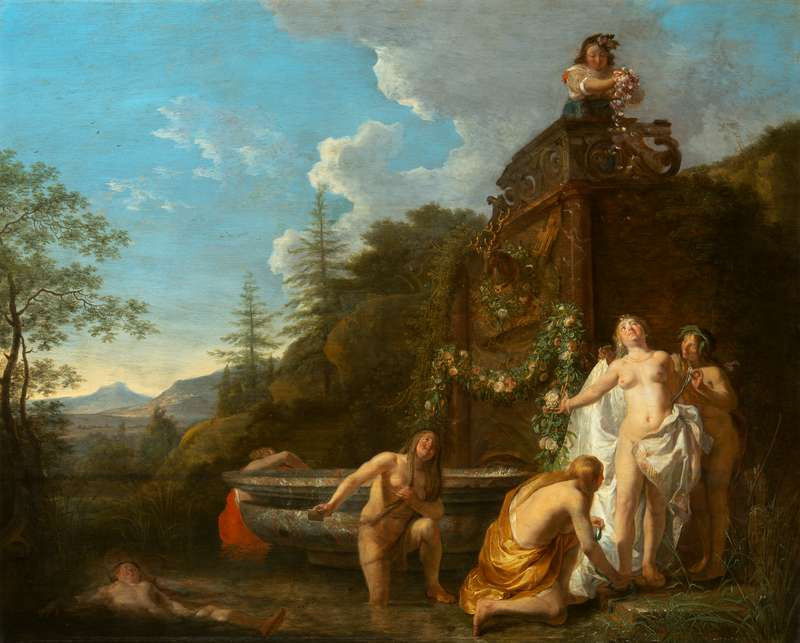
That one naked goddess can be considered Diana. In Hermetic Alchemical terms, Pernety writes that Diana is properly the matter at the white, the colour that appears in the Work before the red, which is called Apollo. At this point, Alors c’est Diane toute nue, Diana is entirely naked. Apollo is the god of light, healing, music, prophecy, poetry and archery, and he is the twin of Artemis, the goddess of the hunt, that is to say the Roman Diana.
And in an entry in Pernety’s Hermetic Dictionary, the entry for Moon expands on this albedo stage:
When the Sages speak of their Moon in this state, they call her Diana, and say that happy is the man who has been able to see Diana completely naked; that is to say, the matter at the perfect white.
The purification achieved, the alchemists speak of the happiness of seeing Diana entirely naked. Unveiling and witnessing truth moves one from an intellectualising of the matter toward an experiential understanding. Though after seeing Truth there is still work to be done. There is the reddening, and that brings us back to the red of the Lust card, which we encountered in the earlier detour.
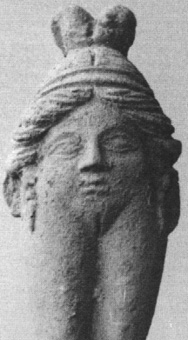
Pernety was writing in the eighteenth century, but a century or so later, Nietzsche in a preface he wrote in 1886 for the second edition of The Gay Science, fourteen years after his earlier meditation in The Birth of Tragedy, he returned to the problem of unveiling Truth, now questioning whether she would remain Truth at all once stripped of her veils. He had grown suspicious of the desire to see everything naked, to understand everything, and to be present at everything, regarding this insistence upon uncovering things as almost indecent. He likens it to the eagerness of young men who enter Egyptian temples at night to unveil their statues, as though nothing concealed ought to remain so. Perhaps we should have more respect for the modesty with which Nature has hidden herself behind riddles and uncertainties. Nietzsche writes: “Perhaps truth is a woman who has reasons for not letting us see her reasons? Perhaps her name is—to speak Greek—Baubo?”
Nietzsche plays upon the German Gründe, meaning reasons or grounds, which Hadot observes has a suggestive double meaning concerning her concealed lower parts. We will get to know Baubo momentarily as the one who raises the garment. Nietzsche goes on to praise the Greeks for knowing how to appreciate surfaces, folds, skin, and appearances, finding in their apparent superficiality a peculiar profundity.
Walpurgis Night, Goethe:
A VOICE.
Old Baubo comes alone; astride
A farrow-sow behold her ride!
CHORUS.
To whom is honour due be honour!
Dame Baubo, advance, and lead the way!
A sturdy sow, with a dame upon her,
Is guide full meet for our troop so gay.
In Greek mythology Demeter is the goddess of the earth, agriculture, and of fertility. She is the “grain-mother”, or “earth mother”. Demeter mourns after the loss of her daughter, Persephone, who had been taken to the underworld by Hades. The Homeric Hymn describes the goddess sitting with a veil over her face, refusing to eat, drink, or speak when absent her daughter. Eventually Iambe makes her laugh through jokes and mockery, then Demeter accepts a drink. (Ἰάμβη – Iambe’s name meaning “banter/abuse/improper speech’). However, Clement of Alexandria’s Orphic telling features Baubo, who also doesn’t allow Demeter to refuse to drink. Only, to get her to laugh, Baubo simply lifts her garment and exposes her genitals.
Empedocles noted that Baubo meant “hollow,” “stomach,” or “belly”, and it’s also been told that the name may be derived from the sound babies make. Speaking of etymology, it’s worth noting Pernety wrote: “Cérès contente part pour Eleusis, & se repose de ses fatigues sur une pierre appelée agelaste.” That is, “Ceres (Demeter), satisfied, departs for Eleusis, and rests from her labours upon a stone called Agelaste.” Agelaste is from the Greek ἀγέλαστος (agélastos), which means in one sense, “not laughing”. She could really use a belly laugh!
The story has an ancient precedent. Minucius Felix from 260 AD, in his Octavius (22), describes the Cynocephalus accompanying Isis and her mourning priests in search for her lost child, Horus, whose discovery causes the goddess and priests to rejoice, and the Cynocephalus boasts of being the discoverer. Firmicus Maternus (De errore profanarum religionum, II) describes Anubis tracking down the scattered limbs of Horus’s father, Osiris, while Ambrosiaster (Quaestiones, 114.11) explicitly describes the Cynocephalus wandering in search of the limbs. Although these accounts seem to identify the Cynocephalus with dog-headed Anubis, they set the table for Pernety, and our exploration as we will soon see.
The act performed by Baubo, this self-exposure gesture, is known as ἀνάσυρμα (anasyrma). So we have the Mother in grieving, and instead of offering consolation, or soothing, Baubo performs anasyrma.
Detour The Alchemical Colours, Diana, and the Daughter (Click to open!)
If tasked with listing the elements and their colour associations, most would likely offer Black for Earth, Red for Fire, Blue for Water, and Yellow for Air. One of the Hermetic formulas preserved by Pernety, however, associates Black with Air, White with Earth, Yellow with Water, and Ruby Red with Fire. These correspondences become more intelligible when understood through the successive stages of the alchemical work, it is our water which assumes these four principal colours, the same mercurial matter receiving different names, forms, and properties as it undergoes transformation
That leaves lots to expand upon, but for brevity we consider Air first as the fertile, generative principle. For example, the vulture was an ancient Egyptian symbol of motherhood, and was believed to conceive without a male (achieving facultative parthenogenesis, virgin birth), being impregnated by the wind itself which became a Hermetic motiff. Horapollo, in his Hieroglyphica, describes the vulture exposing herself to the north wind to conceive her young. As well in the Emerald Tablet of Hermes, it speaks of the wind carrying the offspring in its belly. Horapollo also relates that the vulture, when unable to find food for her offspring, opens her own thigh to nourish them with her blood, which has parallels to the later Hermetic and Christian symbolism of the Pelican.
Earth, meanwhile, becomes white through the albedo, the whitening which follows the blackness of putrefaction. The original matter, the prima materia, has undergone purification, emerging from its darkness into a condition of greater clarity. This is the white swan, the lunar silver, and Diana herself, whom the alchemists speak of seeing naked. The nakedness of Diana is especially significant here, for Pernety explains that to see her naked is to behold the matter brought to its perfect whiteness. The image of the goddess unveiled thus becomes a description of a particular accomplishment within the alchemical work.
From this whiteness the work proceeds toward yellow, the citrinitas, or yellowing. Here we might imagine the mercurial waters which have reflected the silver light of the Moon beginning to receive the warm golden influence of the Sun. The lunar substance is undergoing a further transformation, and the yellow announces the approach of the final redness. At last comes the rubedo, the ruby-red stage, where the work attains its perfection through fixation. That which was previously volatile, liable to escape and change its form in the heat, has been brought into a condition in which it can endure the action of the most violent fire without being destroyed.
This opens a way of also seeing the Rosicrucian emblem of the Ruby Rose upon the Cross of Gold, the cross itself bearing, among its many meanings, the four elements. We might also consider the Pelican striking her breast to feed her young with her own blood, an image sometimes accompanied by the letters INRI, which themselves hint to the four elements in the original Hebrew: Iam, Nour, Ruach, Iabeshah.
The blood of the mother becomes the nourishment of her offspring, and what was contained within her is carried forward into another generation.
In his commentary on the Empress in The Book of Thoth, Crowley writes on this symbolism:
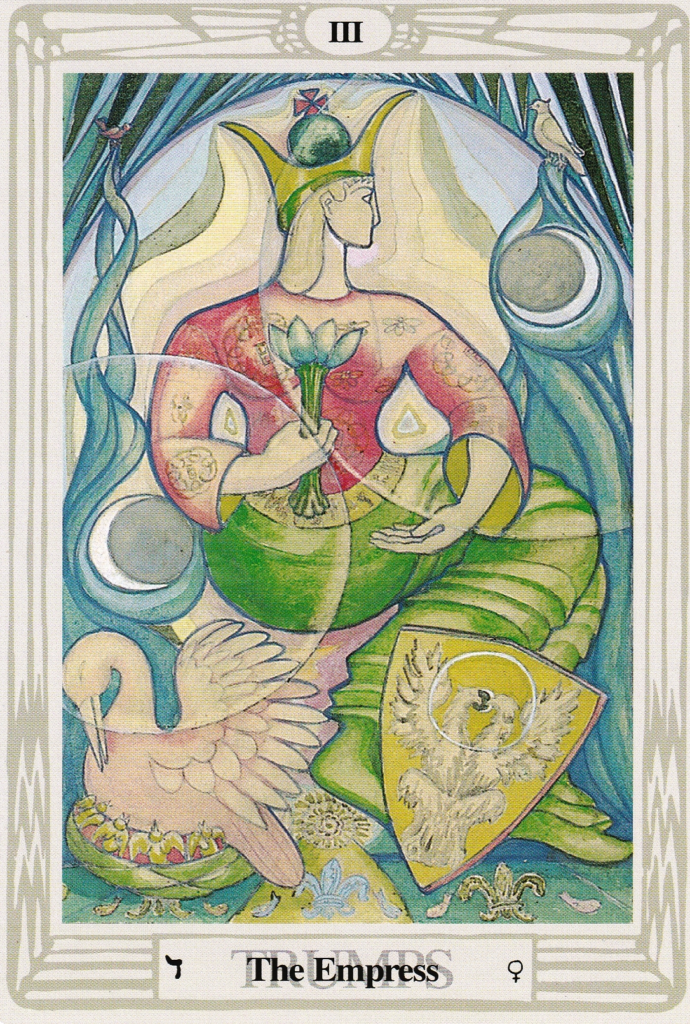
“In general terms, the meaning may be suggested by identifying the Pelican herself with the Great Mother and her offspring, with the Daughter in the formula of Tetragrammaton. It is because the daughter is the daughter of her mother that she can be raised to her throne. In other language, there is a continuity of life, an inheritance of blood, which binds all forms of Nature together. There is no break between light and darkness. Natura non facit saltum. […] For in these highest cards are the symbols of perfection; both the initial perfection of Nature and the final perfection of Art; not only Isis, but Nephthys.”
Natura non facit saltum, “Nature makes no leap”. The Daughter inherits the substance of the Mother and may herself be raised to the Mother’s throne, becoming the Mother in her turn. The apparent distinction between generations conceals a continuity of life which persists through every transformation. Nothing is introduced from outside Nature, and nothing of her essential substance is lost. What appears to be an ending is also the possibility of another beginning. Change is stability.
Crowley’s mention of Nephthys with Isis is also of importance. She is the sister of Isis and the wife of Set, yet joins Isis in mourning Osiris and assisting in his restoration after Set’s murder of him. In Plutarch’s interpretation, Nephthys is associated with the extremities or limits of things, with dissolution and the end, while Isis is associated more directly with generation and the preservation of life. Yet they are sisters, and participate together in the restoration of Osiris. We can see in them the movements of Nature, through which forms are dissolved and generated anew.
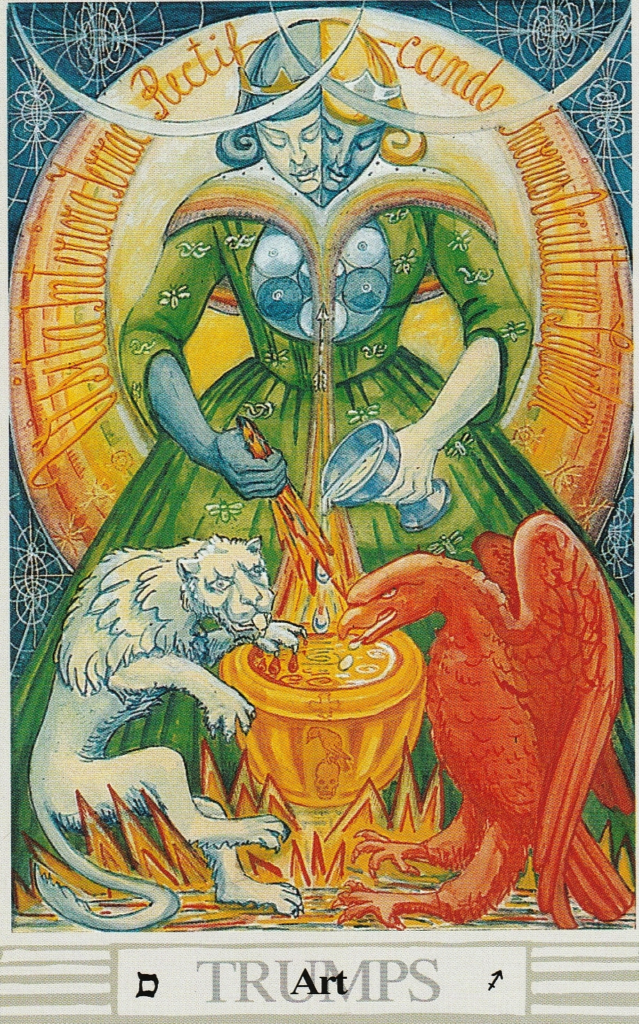
Perhaps, then, we should not be shocked to see the many-breasted goddess Isis appearing in Crowley’s Thoth Tarot in the center of the Art card, Atu XIV. Its zodiacal attribution is Sagittarius, the Archer, and Crowley explains:
“Sagittarius means the Archer; and the card is (in its simplest and most primitive form) a picture of Diana the Huntress. Diana is primarily one of the lunar goddesses, though the Romans rather degraded her from the Greek ‘virgin Artemis’, who is also the Great Mother of Fertility, Diana of the Ephesians, Many-Breasted. (A form of Isis-see Atu II and III.) The connection between the Moon and the Huntress is shewn by the shape of the bow, and the occult significance of Sagittarius is the arrow piercing the rainbow; the last three paths of the Tree of Life make the word Qesheth, a rainbow, and Sagittarius bears the arrow which pierces the rainbow, for his path leads from the Moon of Yesod to the Sun of Tiphareth.”
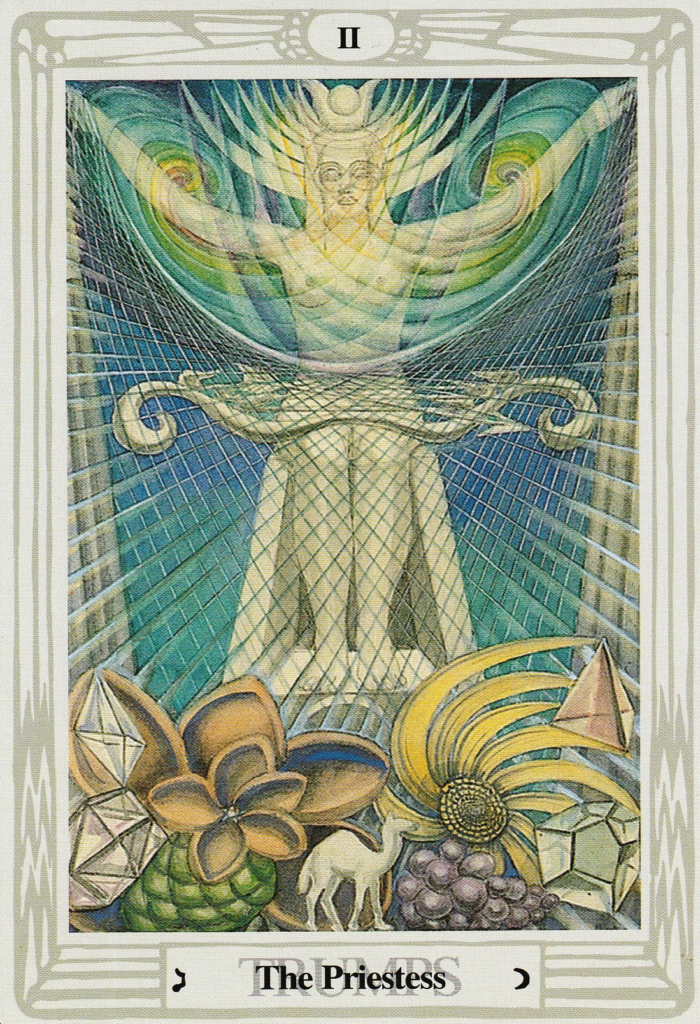
Crowley mentioned Atu II and III. II is The High Priestess, where Crowley wrote of its design:
The card represents the most spiritual form of Isis the Eternal Virgin; the Artemis of the Greeks. She is clothed only in the luminous veil of light. It is important for high initiation to regard Light not as the perfect manifestation of the Eternal Spirit, but rather as the veil which hides that Spirit It does so all the more effectively because of its incomparably dazzling brilliance. [The tradition of the best schools of Hindu mysticism has a precise parallelism. The final obstacle to full Enlightenment is exactly this Vision of Formless Effulgence]. Thus she is light and the body of light. She is the truth behind the veil of light. She is the soul of light. Upon her knees is the bow of Artemis, which is also a musical instrument, for she is huntress, and hunts by enchantment.
Now, regard this idea as from behind the Veil of Light, the third Veil of the original Nothing. This light is the menstruum of manifestation, the goddess Nuith, the possibility of Form. This first and most spiritual manifestation of the feminine takes to itself a masculine correlative, by formulating in itself any geometrical point from which to contemplate possibility. This virginal goddess is then potentially the goddess of fertility. She is the idea behind all form; as soon as the influence of the triad descends below the Abyss, there is the completion of concrete idea.
Atu III is the Empress, whose imagery of the Great Mother we have already encountered in the figure of the Pelican.
Diana is lunar, and therefore associated with Yesod, while her brother Apollo is solar, corresponding to Tiphareth. Apollo is also a god of music, light, archery… The arrow of Sagittarius describes the path between the two sephirots, piercing the rainbow, the differentiated colours, as the work proceeds toward the union of its opposing principles. Upon the Art card we see the mingling of fire and water, the white lion and red eagle, and the conjunction of the masculine and feminine into a single figure. It is the marriage of those principles which were previously separated, their dissolution and recombination into a new form.
This is the work of making the volatile fixed and the fixed volatile, repeatedly dissolving and reconstituting the substance until it attains its perfection. The movement toward the ruby red is therefore more than a succession of colours. It is the transformation of what was once unstable into something capable of enduring, while the very processes of dissolution and generation continue to reveal new possibilities within the original matter.
Pernety provides a particularly illuminating explanation of this continuity when discussing the two Hermetic Moons:
“The Hermetic Moon is of two kinds. The first is their mercurial water, called Isis, the mother and principle of things; which is why Apuleius called her Nature, and has her say that she is one and all things. It is from this Moon that the other is formed, or Isis, the sister and wife of Osiris; that is to say, this same volatile mercurial water, united with its sulphur, and having attained the white colour after passing through the black colour, or putrefaction.”
The two Moons, then, are not two entirely different substances. The second proceeds from the first through transformation, the volatile mercurial water united with its sulphur and brought to whiteness. The substance which begins the work becomes the substance upon which the work is accomplished. Nature provides both the matter and the possibility of its perfection, while Art assists in bringing what is latent within her into manifestation.
Nietzsche chose Baubo as the possible name of Truth. The philosopher wishes to unveil Nature, thinking they can reach the naked thing itself, but why then did he invoke Baubo? Baubo herself performs the revelation.
In the story of Demeter, the Mother mourned the absence of her Daughter, which prevented the earth from baring fruit, and prevented life from flourishing. Persephone had been taken into the underworld, and eventually becomes its queen, and so is bound to return there for a part of each year, providing us then with Winter. When she rises again, the earth rises with her in Spring. The Daughter’s return restores the fertility of the Mother. With the ritual gesture of anasyrma, the condition in which Demeter had become fixed was then interrupted, so was put into motion again.
On the Daughter being raised to the Mother’s throne, Crowley writes in the Vision and the Voice: “And this is that which is written: Malkuth shall be uplifted and set upon the throne of Binah. And this is the stone of the philosophers that is set as a seal upon the tomb of Tetragrammaton, and the elixir of life that is distilled from the blood of the saints, and the red powder that is the grinding-up of the bones of Choronzon.” Choronzon is a Typhon, Chaos figure who fixes and then devours. (And Malkuth, “Kingdom”, is associated with the Earth, the four elements and is the Daughter, while Binah, “Understanding”, is Saturn, and the Mother).
Baubo doesn’t bring Persephone back, yet her act prevents the Mother’s complete withdrawal from life. In The Anasyrma Fertility Ritual in Ancient Egypt: From Hathor to Hermaphroditus it mentions the Chester Beatty I papyrus, which tells of the god Ra being offended by the god Bebon, or Babi (whose name is usually translated as “bull of the baboons”, and has a lot of interesting symbolism that is worth raising here, so let’s go for another very short aside, if you will! (Click to open the detour below)
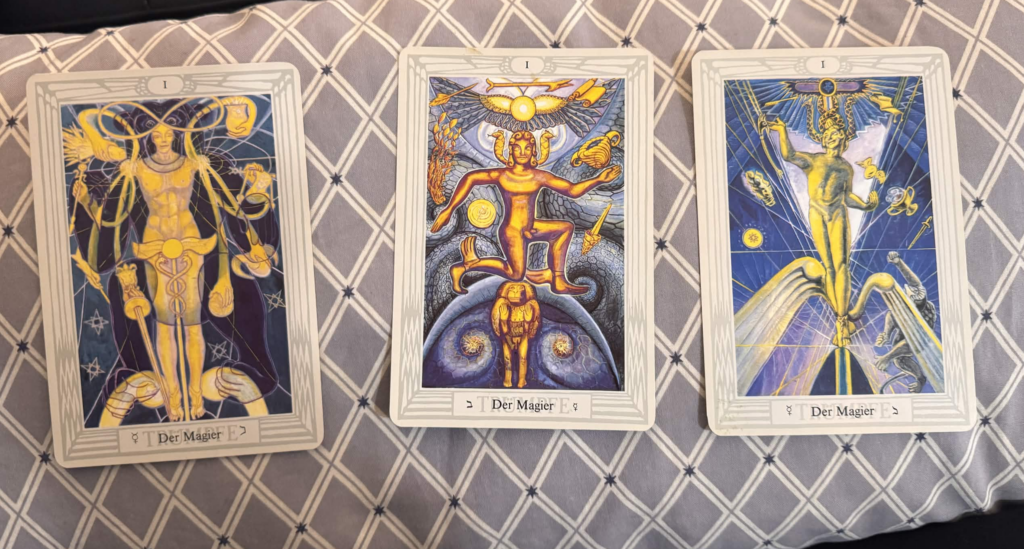
Detour Bebon, the Cynocephalus, and the Magus (Click + to open)
Babi, or Baba (the Greek Bebon), was a fierce deity of the dead associated with extraordinary sexual virility. In the Pyramid Texts (Utterance 313), his phallus serves as the bolt of heaven’s doors, which open when it is withdrawn: “The phallus of Babay is pulled out, the doors of the sky are open.”. In the Coffin Texts (Spell 822), the deceased declares, “I am the phallus of Babi.”
Babi could also assume the form of a dog. In the Papyrus Jumilhac (XVI.14–22), he appears as a red dog who accuses Thoth of stealing offerings belonging to Ra. Thoth retaliates by touching Babi’s penis with his writing reed and uttering a magical formula, causing it to swell during intercourse and trapping him inside his partner. Thoth then summons the gods to witness this humiliation, they laugh at his exposed testicles, and Babi is eventually sacrificed. The story recalls the manner in which dogs become temporarily locked together during mating, which can last anywhere between 5 and 45 minutes.
Elsewhere, in Papyrus Geneva, Babi as a large red dog roams with seventy-seven hounds, which are said to be projections of his own chaotic essence. Isis warned her child from going near Babi, and when he is inevitably bit, he needs to return to Isis for instructions on the cure.
The Greek kynokephalos (κυνοκέφαλος) means “dog-headed,” and in one sense is referring to the baboon’s canine appearance. The Cynocephalus has a considerable place in Egyptian religious symbolism, and later in Hermetic interpretations of it.
Antoine-Joseph Pernety writes in his Dictionnaire mytho-hermétique:
« Cynocéphale. Espèce de singe ayant la tête de chien. Les Egyptiens révéraient beaucoup ce monstre, parce que les Prêtres leur faisaient entendre que c’était Osiris. » (“Cynocephalus. A kind of ape having the head of a dog. The Egyptians greatly revered this creature because the priests led them to believe that it was Osiris.”)
Pernety explains that the priests themselves understood Osiris as the masculine principle of the alchemical Great Work, the Sulphur or Sun, concealed beneath the outward religious symbol. In Les Fables égyptiennes et grecques dévoilées (Book I, Chapter VII), Pernety also writes: “Nothing among the hieroglyphs of the Egyptians is more frequent than the Cynocephalus, because it is properly the figure of Anubis or Mercury.”
Pernety recounts, following Horapollo, that the Cynocephalus was associated with both the Sun and Moon. During the first two or three days of the lunar cycle, when the Moon disappeared from sight, the animal was said to grow melancholy and mourn its absence, as though it had been taken away.
The Cynocephalus was also believed to have shown Isis where to find the body of Osiris, and so was frequently depicted accompanying the goddess and god. For Pernety, these traditions conceal the philosophical Mercury, the indispensable minister of Isis, without whom neither Isis nor Osiris can accomplish the Great Work. When the Cynocephalus carries a caduceus, crescent, or lotus, it signifies philosophical Mercury; when carrying a reed or scroll, it represents Hermes, the inventor of writing and the sciences.
Kenneth Grant wrote in the Magical Revival:
“But the primal type of Duality in Unity was supplied by the dog and ape merged in one image as the cynocephalus. This was the sacred dog-headed baboon used in ancient Egypt as a type of Time (Saturn; feminine; ape) and of the Holy One, or Priest (Mercury; masculine; dog). The Kaf-ape or cynocephalus over shadows the Magus in Crowley’s interpretation of the second Key of The Book of Thoth. He did not publish it in his recension of the Book because it was too explicit; it revealed the essential secret of practical magick.”
This brings us to Crowley’s Book of Thoth, and the Magus (Atu I), where Mercury appears with winged sandals, bearing the instruments of creation, accompanied by the Cynocephalus. Crowley describes Mercury as the bearer of the creative Word, the Logos through whom the worlds are brought into manifestation. Yet the ape accompanying Thoth has another function. The very act of expressing the divine Word through speech or writing introduces the possibility of ambiguity and deception. The Cynocephalus follows Thoth to distort his Word, “to mock, to simulate and to deceive.” Crowley concludes: “Manifestation implies illusion.”
The veil through which we project the world onto obscures our eyes.
In The Vision and the Voice, the 15th Æthyr, OXO, Crowley contemplates a universe of letters which are stars, and a divine Table whose letters contain the names of gods and magical formulae. The letters of the stars are described as their totems, yet a letter cannot represent the whole nature of a star. Each must be known individually, through the wisdom of one who “holds the Cynocephalus in leash”. Crowley’s footnote identifies this figure as Thoth.
Thoth, the divine scribe, transmits the Word through signs, while his accompanying ape introduces their ambiguity. Yet the wisdom of Thoth also requires keeping that ape under control. The letter signifies the star, but the star exceeds the letter.
One last curiosity. Plutarch writes in On Isis and Osiris (section 49) that some considered Bebon a companion of Typhon (Seth), while Manetho regarded Bebon as another name for Typhon himself. He explains the name as signifying “restraint” or “hindrance,” the power which obstructs Nature’s proper movement:
σημαίνει δὲ τοὔνομα κάθεξιν ἢ κώλυσιν, ὡς τοῖς πράγμασιν ὁδῷ βαδίζουσι καὶ πρὸς ὃ χρὴ φερομένοις ἐνισταμένης τῆς τοῦ Τυφῶνος δυνάμεως. (“And the name signifies a holding back or hindrance, since the power of Typhon opposes things as they travel along their path and are carried towards that to which they ought to go.”)
Babi’s phallus opens the gates of heaven, yet becomes the instrument of his own restraint through the magical Word of Thoth. What once opened the way is made to hold him fast.
Oh, and it is almost worth putting a detour within the detour! Grant mentioned Saturn and time (attributions also of Binah), in Egypt they had two means of telling time, being sun dials, and water clocks. Many of these water clocks would have a cynocephalus standing split legged over the receptacles, as baboons were observed to urinate at perfectly regular intervals twelve times a day.
Babi also belongs tot he imagery surrounding judgement and the dead. In the ritual of the afterlife and the weighing the heart against Ma’at’s feather, Bebon also sits on the tip of the scale, observing the balance. Bebon devours all in an instant, and lives off the entrails of the dead, and those who fail to pass the scales.
Those who do pass having their heart weighed by the feather of Ma’at are escorted by Horus and granted the name of Truth.
It should perhaps be no surprise that the Master of the Temple’s name is Truth:
“For two things are done and a third thing is begun. Isis and Osiris are given over to incest and adultery. Horus leaps up thrice armed from the womb of his mother. Harpocrates his twin is hidden within him. SET is his holy covenant, that he shall display in the great day of M.A.A.T., that is being interpreted the Master of the Temple of A.’. A.’., whose name is Truth.”
– LIBER A’ASH VEL CAPRICORNI PNEUMATICI
So the Iapyrus Jumilhac has Babi appear as a red dog, whom ends up on Thoth’s sacrificial block. The Papyrus Geneva tells of Isis warning Horus from being in the presence of Babi who roams with 77 dogs. He ends up getting bit on the ankle and needing Isis’s cure.
The last account is interesting, as there’s another tale of Ra growing old and drooling as he makes his walk across Egypt. In this story, if bitten by any regular serpent, Ra would have the antidote within him as as he had created the serpent as he created all things. A sorceress named Isis, however, collects clay that she made by mixing the dirt with Ra’s own saliva, and from this she fashions a cobra, the Uraeus. Bitten on the ankle and poisoned by this creation made in part from his own divine substance, he turns to all the gods for help. Being the only one to know the remedy, Isis demands that he provides her with his true name. In another telling she also demands that Ra give Horus his eyes, which are the Sun and the Moon.
Ra is crying out in suffering with the burning poison, both freezing and boiling. First, he lies to Isis and gives the names of his creations, saying: “I am Khepera in the morning, Ra at noon, and Temu in the evening!” Finally, Ra breaks down and passes the secret name from his heart to her heart, which she uses to crown Horus, the crowned and conquering child.
“Is a God to live in a dog? No! but the highest are of us. They shall rejoice, our chosen: who sorroweth is not of us.”
We saw earlier what broke the fixation of sorrow. In a 12th century BC text known as the Contentions Between Horus and Seth, which tells of the Ennead, the divine council decided who would take the throne of Osiris between Horus and Set. The debate went on for decades. Ra eventually leaves the council, being driven out, frustrated by the discouraging words of the ape god Bebon, or Babi, who told him, “your shrine is empty”. As Ra is the sun, and the source of Ma’at, the world was to plunge into darkness and chaos. That is until the goddess Hathor (whose name means “house of horus”) approached Ra and performed the ἀνάσυρμα ritual, the lifting of the garment to expose her genitals, which produced laughter from Ra. And so Ra comes out of hiding.
Plutarch provides an expression of Nature’s generative activity in his On Isis and Osiris where he mentions the sistrum, a sacred rattle associated with Hathor and Isis, and how it embodies the perpetual movement of Nature. Plutarch explains this instruments rounded upper frame with four rattling bars, representing the four elements of fire, earth, water, and air. These constitute the mutable world beneath the moon, where all things are subject to generation, destruction, motion, and change. At the top of the instrument is the figure of a cat with a human face, while beneath the rattling bars are the faces of Isis and Nephthys.
(Coincidentally Isis and Bastet, the cat goddess were merged in the Greco-Roman creation of Isis-Bubastis, who was depicted in terracotta figures of doing the anasyrma ritual, lifting her garment and exposing her genitals).
The sistrum instrument itself expresses the necessity of movement. Plutarch writes that all things in existence must be shaken or rattled about, never permitted to cease from motion, but awakened and agitated whenever they grow drowsy and torpid. The shaking of the sistrum is said to repel Typhon, the principle of destruction, for whenever destruction constricts and checks Nature, generation releases and arouses it through motion.
Nietzsche connecting Baubo to Isis, had me inevitably return to Crowley. In Part 1 we read from the Book of the Law, how the elements are “Nuit— Space— that is, the total of possibilities of every kind” and its counterpart “Hadit, any point which has experience of these possibilities”. We also saw Kenneth Grant expanding on the BoTL line about Nuit and Isis, marking the distinction: “Isis is terrestrial space, illuminated by the stars. Nuit is outer, or infinite space, the undying darkness that is the hidden source of Light; She is also, in a mystical sense, Inner Space and the Great Within.”
We can give more credibility to this interpretation, as Crowley himself remarked on similar distinction where he wrote in Liber LXV:
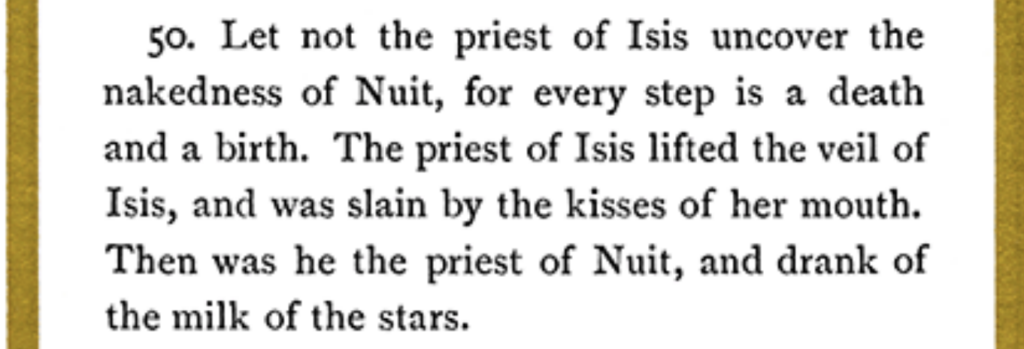
Babes love, or live to drink milk. With Belly, or Baubo, I couldn’t help but be reminded of Book of the Law’s second chapter, where Hadit addresses the people of sighing, leaving sorrow and regret to the dead and dying. There Hadit states that their own nature is: “Beauty and strength, leaping laughter and delicious languor, force and fire, are of us.”
Then there is verse 52 which is most fitting to this veil of sorrow we’ve imagined:
“There is a veil: that veil is black. It is the veil of the modest woman; it is the veil of sorrow, & the pall of death: this is none of me. Tear down that lying spectre of the centuries: veil not your vices in virtuous words: these vices are my service; ye do well, & I will reward you here and hereafter.”
Baubo, Truth. Many on the Path feel that they are either on, or off the Path. Either dead or living, based on whether or not they can accept their actions as being chosen. They feel asleep when between tasks designated as intentional, meditative, or being worthy of conscious attention. They hide their shame around their leisure and ignore events where their nature is revealing itself in them: “veil not your vices in virtuous words.”
Crowley wrote a commentary upon the fifty second verse saying from light we turn to the absence of light. Yet, he says, this is not real. It is a veil, not in the order of nature. “It has been made by shame and fear, by trying to shut off all that is true and real from the soul.” He says that to resist change and to defy nature, this is the “key of the evil Magic[…] Her veil is sorrow and death.” He says that those of Thelema worship Nuit: ‘all that may be’ adored by ‘all that is.'”
Ἡ φύσις τῇ φύσει τέρπεται, καὶ ἡ φύσις τὴν φύσιν νικᾷ, καὶ ἡ φύσις τὴν φύσιν κρατεῖ.”
(“Nature delights in nature, nature conquers nature, nature masters nature.”)
Perhaps this sheds light on “He that is righteous shall be righteous still; he that is filthy shall be filthy still.”, as well as “Yea! deem not of change: ye shall be as ye are, & not other.”
Verse 52 commentary continues:
“Yet more. The veil is vile. We must not, as the master class of men do now, enjoy ourselves in every way, and pretend with utmost care that we do nothing of the sort. We must take pride in our pleasure. We must be shameless and frank. Since all that is, is God, the only error is to hinder God from being himself or doing his will, or unveiling his truth.”
And elsewhere, he proclaimed that our minds and bodies are “veils of the Light within.” He taught that the Great Work consists in making these veils transparent, and that purification is really simplification. Not that the veil is dirty, just its folds have become too complicated for the Light to pass through clearly.
Baubo and exposing nature is not just being honest of one’s vices, what we are which we ignore, or rewrite to maintain a narrative we tell ourselves about ourselves. Seeing the naked thing itself, reality as it is, may require us to laugh at it and ourselves… Crowley wrote: “I breathed out and felt a kiss swifter, more laughterful than death itself. Utter relief from all the deceits with which my brain had been blinded.”
Laughter is a powerful tool to slay one’s conception, or misconception of themselves and a useful tool to keep oneself sane in a world of illusion. Crowley wrote:
Beyond all this for practical value—since the signpost at every turn of the Path of the Wise reads DANGER—yet springing directly from it by virtue of this very slaying of the Ego, is the use of Laughter as a safeguard of sanity. How easy for the charlatans of oratory to seduce the simple enthusiasm of the soul! What help have we unless we have the wit to know them as ridiculous? There is no limit to the abyss of Idiocy wherein the quacks would plunge us—our only saving reflex is the automatic joke of the Sense of Humour!
In the essay titled Laughter, Crowley also wrote: “No, the Universal Joke, though it be not a true Trance, is most assuredly a means of Grace, and often proves the chief ingredient of the Universal Solvent. The common defect of all mystical systems previous to that of the Aeon whose Law is Thelema is that there has been no place for Laughter. But the sadness of the mournful Mother and the melancholy of the dying Man are swept in the limbo of the past by the confident smile of the immortal Child. And there is no Vision more critical in the career of the Adept of Horus than the Universal Joke.”
The mournful Mother and the dying Man may be considered the Alchemical Isis and Osiris. Horus is the immortal Child. That becomes especially interesting alongside the call to tear down the black veil of sorrow, and now, after Baubo and Hathor, with Crowley’s talk of laughter as a means of Grace.
What had become fixed in stagnation is interupted. Demeter remains the Mother of Persephone and Persephone is still absent. Ra has not been persuaded by some great philosophical argument, nor has the offence against him been erased. Yet both gods laugh, and with that laughter the world is permitted to move again. Plutarch’s sistrum shakes things from their torpor, arousing what had become stagnant, and generation continues its work.
We considered the relationship between the Mother and Daughter in our alchemical detouring. The Pelican feeds her young with her own blood, and Crowley remarks on the continuity of life which binds all forms of Nature together. Natura non facit saltum. Nature makes no leap. There is no break between light and darkness, nor between the generations. What appears to be a seperation is also the means through which the continuity becomes visible.
In the formula of Tetragrammaton, the Son takes the place of the Father, while the Daughter becomes the Mother in her turn. What was generated becomes generative. Nature has not departed its form, but has assumed another.
Let’s go back to Demeter. Persephone is not merely the child who has departed. She has also become Queen of the Underworld, and her descent and return participate in the recurring transformations of the earth. The Daughter has acquired a place of her own, and the Mother must contend with the fact that her child is no longer present to her in the same way. Perhaps something of the Mother’s sorrow lies in the desire to preserve one particular relationship against the very movement of Nature. Yet to preserve the Daughter forever as the child who has not departed would be to deny her becoming.
Yet the Mother is inexhaustibly generative. Her unveiling is also the disclosure of her generative nature. And the Child is the event of that disclosure. Nuit rejoices in the birth of all that comes forth. Crowley writes that all events are children of Nuit, that every event fulfils some Love, and that each becomes part of her Body, whose Soul is Lust to bring forth. The Mother gives birth to innumerable children, and her joy is not exhausted in any one of them.
In this sense we might regard the event as one of the appearances of the veiled goddess, another form through which Nature reveals herself. Like in Part 1 with Signs and their interaction in the semiosphere, so too is an event is born, enters into relationships with other events, and passes. Yet its departure is not necessarily the disappearance of everything it has brought into being. Something of it may remain, transformed through what follows.
In Part One we examined the life of signs and the manner in which their histories become part of their meaning. We saw with Lotman how a sign accumulates memory, how it survives in new relationships, and how a text can continue generating meanings unavailable to it at its beginning. But there is an important distinction between an event continuing to have meaning and demanding that the event itself should never have ended.
To wrap up, let’s go back to the beep beep. Bernie is no longer here, yet the sign continues to carry something of the events through which it came into being. The history has not been erased, nor could it be restored to precisely what it was before her passing. The sign lives on under changed circumstances. It has become capable of carrying an absence which was not part of its meaning when we first began using it.
The memory has not prevented the sign from continuing its life. The change has become part of that life. We need not discard the memory of an event to cease being bound by it. And perhaps what binds us is not so much the event itself, but the particular account of it which we have come to regard as indispensable.
This is not only relevant to a matter of grief. One can become similarly fixed upon a moment of happiness, an accomplishment, a position, a conception of oneself, or even a spiritual experience. We distinguish between events that we consider meaningful and the innumerable mundane events which seem to interrupt them. We go about our daily lives imagining that we are somehow between moments of genuine participation, awaiting the next occasion in which we will be fully present.
“Every accretion must modify me. I want it to do so. I want to assimilate it absolutely. I want to make it a permanent feature of my Temple. I am not afraid of losing myself to it, if only because it also is modified by myself in the act of union. I am not afraid of its being the “wrong” thing, because every experience is a “play of Nuit,” and the worst that can happen is a temporary loss of balance, which is instantly adjusted, as soon as it is noticed, by recalling and putting into action the formula of contradiction.”
But what are these intervals between selected events, if not events themselves? Nuit has not ceased being Nuit while we are distracted, embarrassed, bored, or occupied with some matter we consider unworthy of our spiritual attention. The events we neglect are not outside Nature. They too are the children of Nuit and all blood must go into Her cup.
There is a peculiar vanity in imagining that Nature is expressing herself most fully when we happen to approve of what is occurring. We can make a great ceremony out of our chosen moments of attention, while treating the rest of our lives as something to be overcome, excused, or endured. And when we fail to live according to the image we have constructed, we may conceal the event beneath another veil, rewriting it until it agrees with what we believe ourselves to be.
Recall Crowley’s warning against veiling our vices in virtuous words. What are we protecting when we do this? Perhaps not the truth of the event, but the conception of ourselves which the event has threatened. And what a ridiculous thing it can be, to spend so much of one’s life defending an image against the very experiences through which that image is continually being transformed!
The laughter which slays the ego may be understood not as a rejection of experience, but as an interruption of our insistence upon possessing it. It exposes the seriousness with which we have invested our own illusions, and allows something else to become possible.
As Zen Master Huangbo taught:
Do not permit the events of your daily lives to bind you, but never withdraw yourselves from them. Only by acting thus can you earn the title of “A Liberated One”.
We can’t confuse freedom from being bound by events with a refusal to participate in them. The withdrawal of Demeter is an illustration of this danger. Her sorrow becomes a condition in which she can no longer receive what is before her. Baubo does not teach her to renounce the world, but brings her back into participation with it.
To stop means simply to die: “The joy of life consists in the exercise of one’s energies, continual growth, constant change, the enjoyment of every new experience. To stop means simply to die. The eternal mistake of mankind is to set up an attainable ideal.”
Crowley provides us this description of Hadit which helps:
Hadit is the Magician: that is, one who causes phantoms to arise: for all His Works with Nuit are but emblems chosen to show forth His Nature as it takes this Form or that, at its pleasure. He is the Exorcist: His Oath hath this Virtue, to drive away those phantoms as soon as their work is done, lest they be taken for things real. For all events are but tokens of His Being, as it appears in union with one or other form of Nuit, and in themselves but symbols. Hadit is that about whom all Events move. He is the Real, straight, square, and solid, in the midst of Perfection, which is none the less curved (that is, of female nature) equal at all points from Him, and real to thought, not to sense. He, being moved by each Event, goeth ever, and saith not ‘Come unto me,’ that Word of his Bride Nuit.
Hadit is the Magician who causes the phantoms to arise, and the Exorcist who drives them away once their work is done. Their appearance is no error, nor is their departure a failure. They are the emblems through which his Nature is expressed in union with Nuit, but none of these emblems are to be mistaken for the whole of what is being expressed. We identified this in the Cynocephalus who accompanies Thoth and mocks the Word, reminding us of the ambiguity introduced through manifestation. To mistake the sign for the entirety of what it signifies is to become caught in the very illusion through which something has been disclosed.
Yet the answer is not to do away with the signs. As mentioned in Part One, the lamp does not become useless because it cannot illuminate everything. Nor would we see more clearly by extinguishing it. The same may be said of the events of our lives. They are the forms through which we encounter Nature, and through which Nature encounters herself. We need not deny their reality as experiences simply because no particular event exhausts what may be experienced. Nor need we demand that one remain forever, as though its departure would deprive us of everything it had revealed.
The veil is not divorced from the goddess.
Thus we have Nietzsche’s suggestion that Truth might be Baubo. We have spent so long imagining the final unveiling of Nature, the discovery of the naked thing itself, that we may have overlooked the manner in which Nature is continually exposing herself through her manifestations. Even the naked Diana of the alchemists is not the end of the Work. The matter has attained its perfect whiteness, and there is still the reddening. One unveiling has been accomplished, and another transformation awaits. Change is stability.
Yet Nietzsche’s Baubo presents that the philosopher has laboured to uncover the goddess, imagining what he might discover beneath her coverings, and now the goddess herself raises the garment. And what happens? The Mother laughs. There is no final explanation, no proposition which resolves every uncertainty, no possession of Truth which puts an end to further experience. But something has been interrupted. The solemnity with which the Mother had become fixed upon her sorrow gives way to laughter, and she is once again capable of receiving what Nature has to offer.
Perhaps there is something to be learned from that whenever we find ourselves upon the stone of Agelaste, convinced that the sorrow, the shame, or the story we are telling about ourselves must be preserved at all costs.
“Remember all ye that existence is pure joy; that all the sorrows are but as shadows; they pass & are done; but there is that which remains.”
Nature has not ceased to hide herself, nor has she ceased to reveal herself. And should we imagine that we have finally discovered the naked Truth, we might do well to remember that the goddess herself is capable of lifting her garment.
Crowley mentioned the reorganizing the Tree of Life, and had made some changes in his Thelemic Qabalah. His magical child, Frater Achad, would take the Book of the Law’s verse on “Tzaddi not being the Star”, and kept Tzaddi the Star, who is Not. Crowley had The Empress on the path between Chokmah and Binah, where Achad had this path devoted to Tzaddi, the Star. Achad’s description read: “The nude figure is the symbol of Isis, Nepthys, and Hathoor. She is Aima, Binah, and Tebunah, the Great Supernal Mother Aima Elohim pouring upon Earth the Waters of Creation. In this Key she is completely unveiled.”